Our strengths
What do numbers you can actually run a business on look like? We decide how your books are kept, and how they are checked, starting from how the numbers will be used.
AI does the processing. Professionals make the judgment calls.
Every day, we use AI we built ourselves to draft journal entries, compare them with how similar transactions were recorded before, and check how the numbers move from month to month. Because AI handles much of the processing, our staff, together with our certified public accountants (CPAs) and certified public tax accountants (zeirishi) licensed in Japan, can spend their time on professional judgment and on your questions. We incorporate what we learn from each review into the processing rules to improve accuracy in the months that follow.
Note: In the US, this model, where accounting goes beyond record-keeping to cover controls and management insight as a single function, is called Client Advisory Services (CAS).
Working from invoices, bank statements, contracts, and what was discussed in meetings, it drafts journal entries under each client's own rules, compares them with how similar transactions were recorded before, and checks how the numbers move each month.
Staff review the AI's output, and CPAs and certified public tax accountants decide matters that call for professional judgment. What was checked and the reasons for each decision are kept on record.
Issues and decision criteria identified in review are written into the processing rules. From the following month, processing runs on the updated rules.
Your accounting data stays in your accounting software. The processing rules and review steps we set for you are also recorded so your team can take them over. Your data is kept separate from other clients' data.
Once you know which numbers you want to see, you know how to keep the books.
Using samples, we show how the intended use of the numbers shapes how entries are recorded and what we check each month.
How you measure advertising performance changes which accounts are used
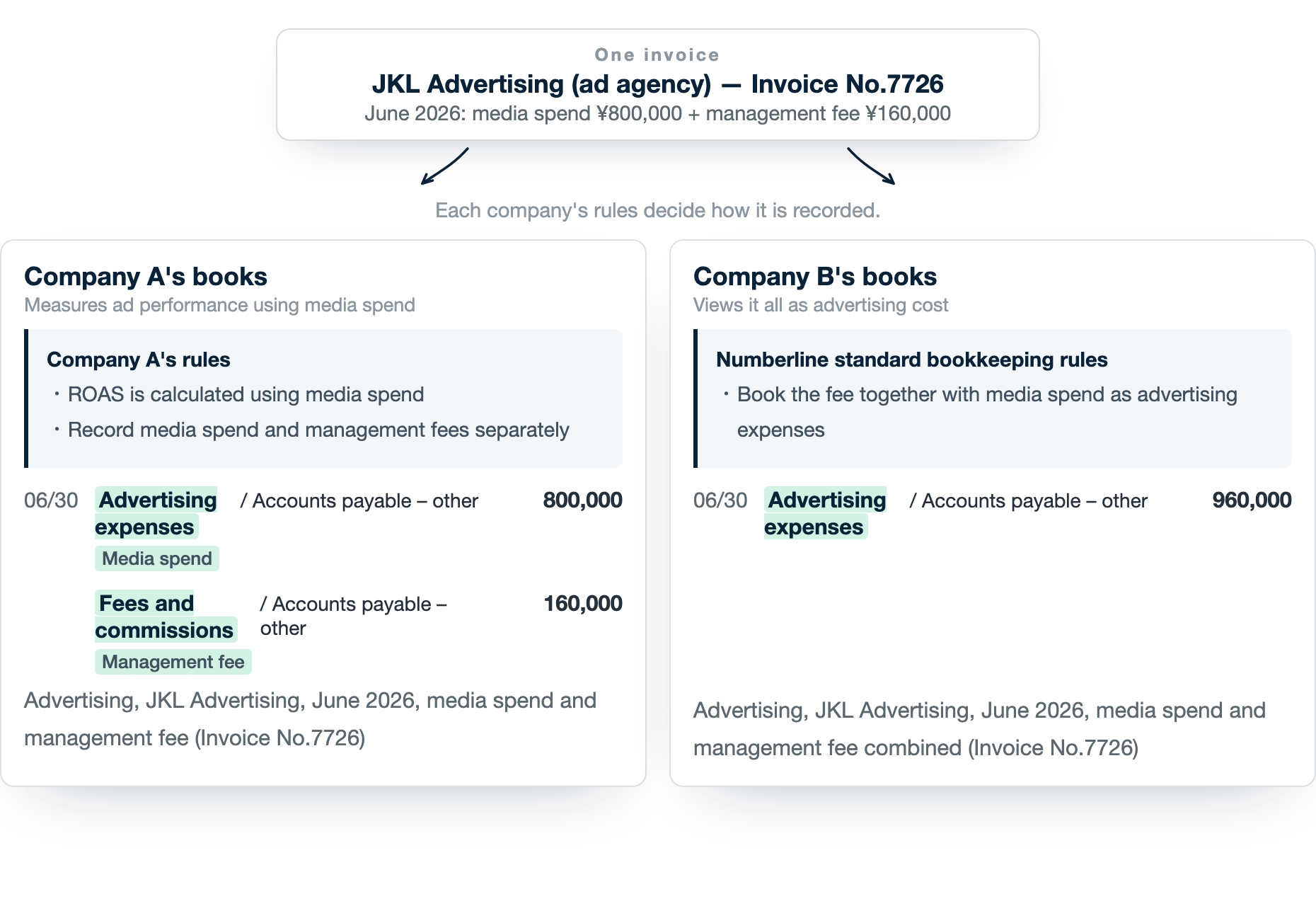
When you measure ad performance, do you count media spend only, or agency management fees as well? Depending on how you define the denominator of ROAS, the same invoice can be booked to different accounts.
ROAS is the ratio of sales to advertising spend. Whether the denominator includes only media spend, or also management fees and production costs, differs from company to company.
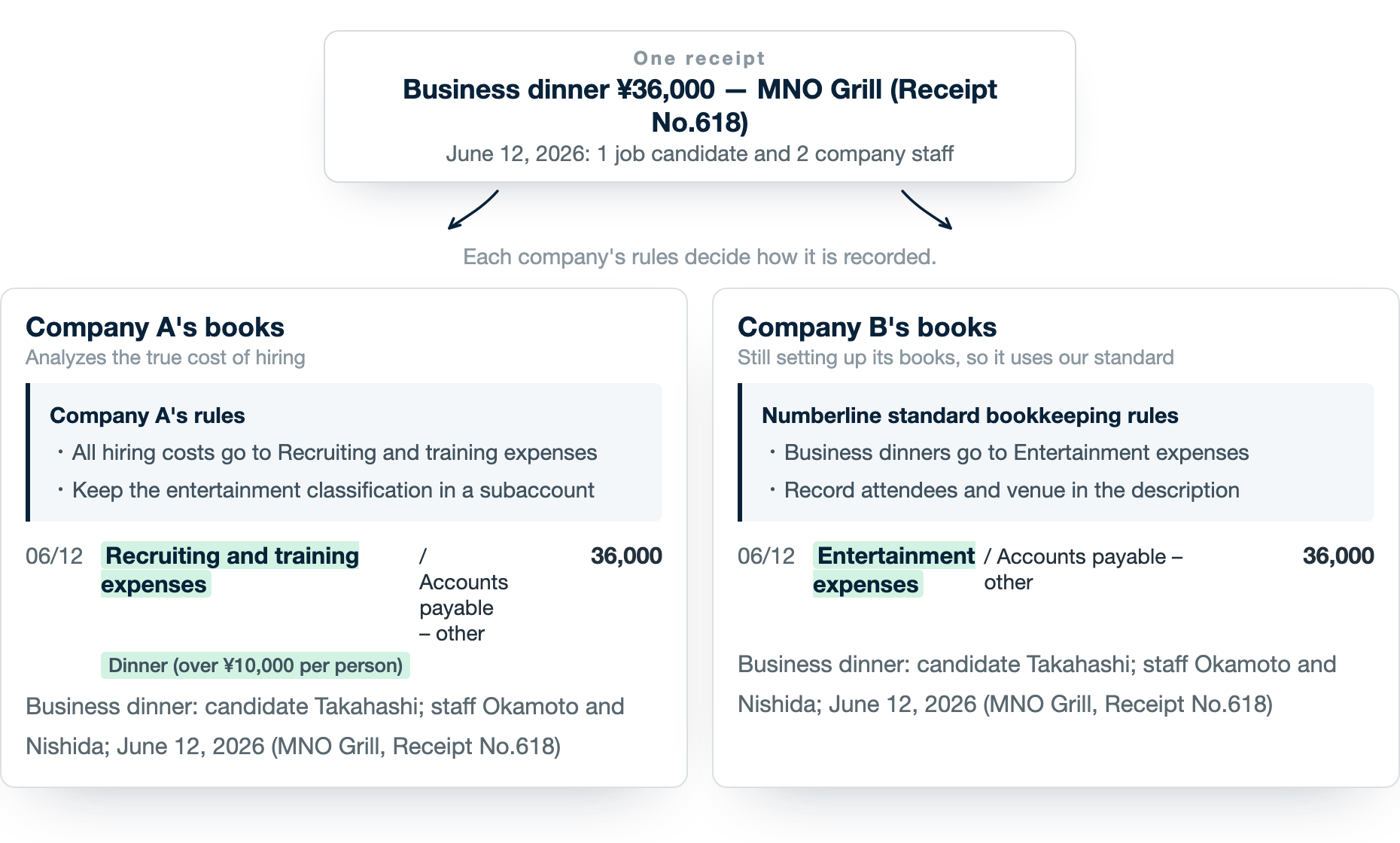
Books organized for management still keep the categories needed for tax filing
For a company that wants to see the true cost of hiring, we record recruiting-related business dinners under "Recruiting and training expenses." We use sub-accounts to preserve the distinction between entertainment expenses and other expenses for Japanese corporate tax purposes, so the tax advisor can extract the totals needed for filing directly.
Trace any number back to its supporting documents
Account names and descriptions follow your accounting policies, manuals, and rules. Information such as document numbers, original currency, and exchange rates is kept in traceable form, as needed for monthly analysis and for explanations to your audit firm or tax advisor.
Document number ─ The vendor's invoice number is copied into the description as is, so you can go straight from the books to the document.
Foreign currency transactions ─ Besides the yen amount, the description keeps the original currency amount and the exchange rate used.
Line-by-line entries ─ Even a single invoice is split by line item, and phone charges are booked to the department of the person using each number. The payable is recorded as one entry.
| Date | Debit | Credit | Amount (JPY) | Description |
|---|---|---|---|---|
| 06/15 | Outsourcing fees | Accounts payable – other | 440,000 | Delivery outsourcing, ABC Logistics, June 2026 (Invoice No.1184, due end of July) |
| 06/19 | Communication expenses | Accounts payable – other | 522,271 | [USD 3,240.50 at ¥161.17/USD (TTM)] Server usage, AWS, June 2026 (Invoice #1594736218) |
| 06/25 | Communication expensesSales | 24,200 | Phone charges, June 2026 (03-XXXX-XXX1) | |
| Communication expensesDevelopment | 13,750 | Phone charges, June 2026 (03-XXXX-XXX2) | ||
| Communication expensesAdministration | 9,350 | Phone charges, June 2026 (03-XXXX-XXX3) | ||
| Accounts payable – other | 47,300 | Phone charges, NTT Communications, June 2026 (Invoice No. C-260620, due end of July) | ||
| 06/28 | Accounts receivable | Sales | 3,300,000 | System maintenance, DEF Trading, June 2026 (Acceptance certificate No. 20260628, payment due end of July) |
| 06/30 | Maintenance fees | Prepaid expenses | 35,000 | Maintenance fee amortization, GHI Systems, June 2026 (annual payment, recorded January 2026) |
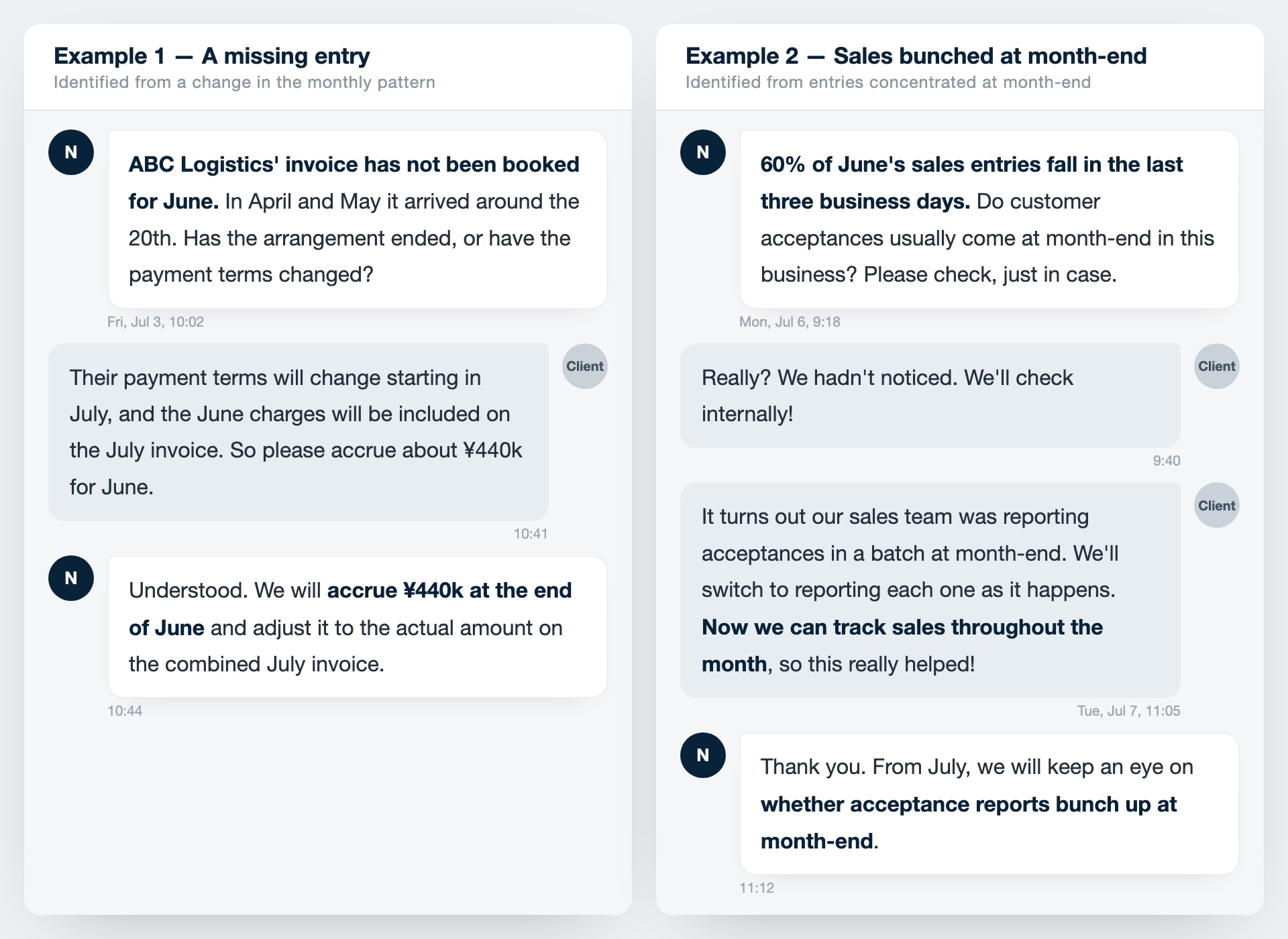
Spot unusual numbers before the monthly close
Along with tracking which invoices have arrived, we check transactions recorded differently from before and items that stray from the usual monthly trend, and compile them into questions for you. Missing entries and processing errors are corrected before the monthly close.
* All books, conversations, and figures shown are samples.
* The account structures and bookkeeping rules on this page are examples of how we run bookkeeping and accounting work, and are not tax advice. Tax treatment depends on the facts and the laws in force at the time, so please consult a certified public tax accountant.
The people who handle the monthly close and those who use financial information to run a business are on the same team.
For example, team members with backgrounds like these handle the work.
Worked on audits at an audit firm, then oversaw budget-to-actual comparisons and cash management as head of administration at an operating company.
After working at an audit firm and a tax accounting firm, managed the monthly close as an accounting manager at a startup.
At a tax accounting office, handled everything from outsourced bookkeeping to preparing corporate tax, consumption tax, and income tax returns.
We assemble a team to handle day-to-day accounting or financial support, depending on the scope of your engagement.